How to identify a Spitfire, and which mark it is
Start with the wing, then count the propeller blades. Our own schematics, plus period photos to test yourself.
Is it a Spitfire?
The elliptical wing became the Spitfire’s most distinctive feature. Smithsonian National Air and Space Museum: Supermarine Spitfire HF. Mk. VIIc The familiar features carry through the Merlin marks: the wing shape, the curved underside and the small fin and rudder. IWM: The evolution of the Supermarine Spitfire (video transcript)
Spitfire or Hurricane?
The Hurricane had a traditional wood-and-metal framework covered in fabric. The Spitfire had an advanced all-metal airframe. IWM: Iconic aircraft of the Battle of Britain The Spitfire took longer to build and was less sturdy than the Hurricane, but faster. The Hurricane was easier to maintain and repair. IWM: Iconic aircraft of the Battle of Britain
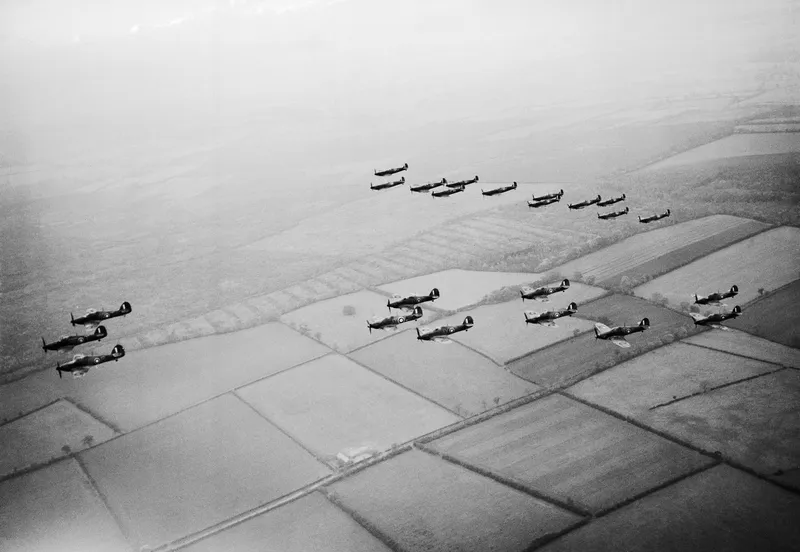
1. The wingtips
Most Mk Vs had their wingtips removed to improve low-altitude performance, and these low-altitude fighters carried the prefix L.F. National Museum of the US Air Force: Supermarine Spitfire Mk. Vc A wartime film describes the Mk V as essentially a Mk I or II with squared-off wingtips, mostly seen with cannon. IWM: The evolution of the Supermarine Spitfire (video transcript)
The Mk VII was the second high-altitude version, with a pressurised cockpit and extended wingtips. Only 140 were produced. Smithsonian National Air and Space Museum: Supermarine Spitfire HF. Mk. VIIc
Our own schematic of one wing seen from above, root on the left. Not to scale and not a plan of any real aircraft.
2. Count the propeller blades
Propeller drawings are our own schematics, seen from the front. Blade shapes are simplified.
3. Look underneath
On a Mk IX, look for the longer nose and two symmetrical radiators. IWM: The evolution of the Supermarine Spitfire (video transcript)
4. Guns and wing letters
Wing letters showed the armament: the Mk Va had eight .303 Browning machine guns, the Mk Vb two 20 mm Hispano cannon and four machine guns, and the Mk Vc a ‘universal’ wing for different combinations. National Museum of the US Air Force: Supermarine Spitfire Mk. Vc Over the war, the eight .303 machine guns gave way to four 20 mm cannon. By the end there were more than 20 fighter versions alone, with Merlins of up to 1,760 hp. Britannica: Spitfire (John F. Guilmartin)
5. The odd ones
Early Spitfires had one wing painted white underneath and one black, so British gunners could recognise them. The idea was soon dropped, because the Germans would know it too. IWM: The evolution of the Supermarine Spitfire (video transcript) The F.24’s five-bladed propeller turned the opposite way to a Merlin Spitfire’s, and it had a much bigger tail and rudder. IWM: The evolution of the Supermarine Spitfire (video transcript)
IWM says MH434, a Mk IX at Duxford, probably started down the Castle Bromwich line as a Mk V: its tail fin is exactly the same as a Mk V’s. IWM: The evolution of the Supermarine Spitfire (video transcript) · checked 29 Oct 2026
Test yourself
Four period photos. Have a guess, then open the answer.
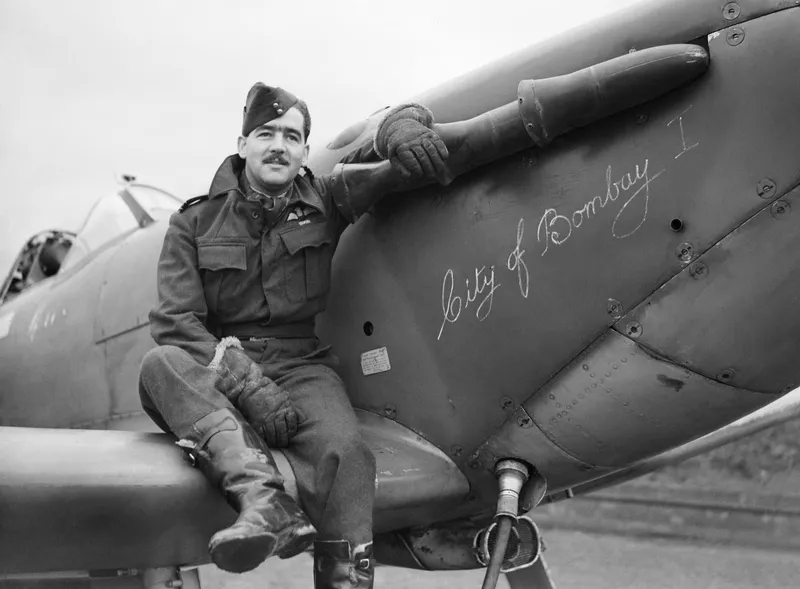
Which mark is it?
A Spitfire Mk V of No. 122 Squadron, December 1941 (from the IWM caption).
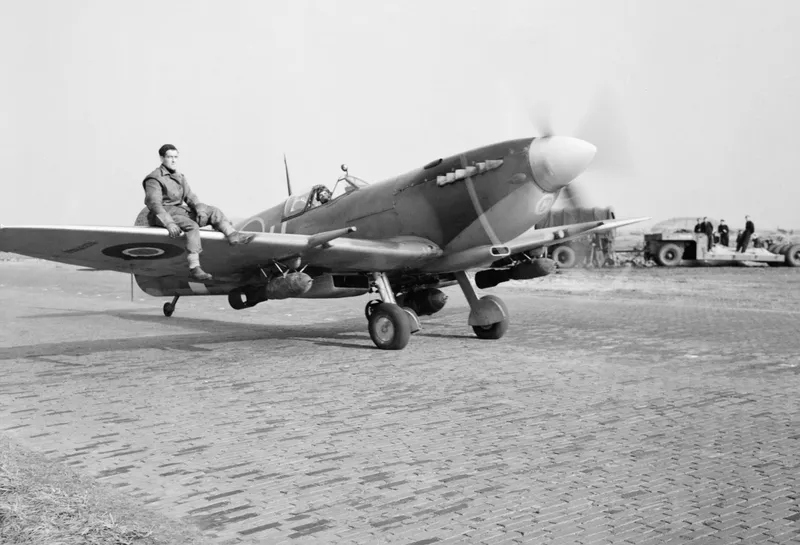
Which mark is it?
Mk IX (No. 412 Squadron RCAF, October 1944). Look for the four blades and the longer nose.
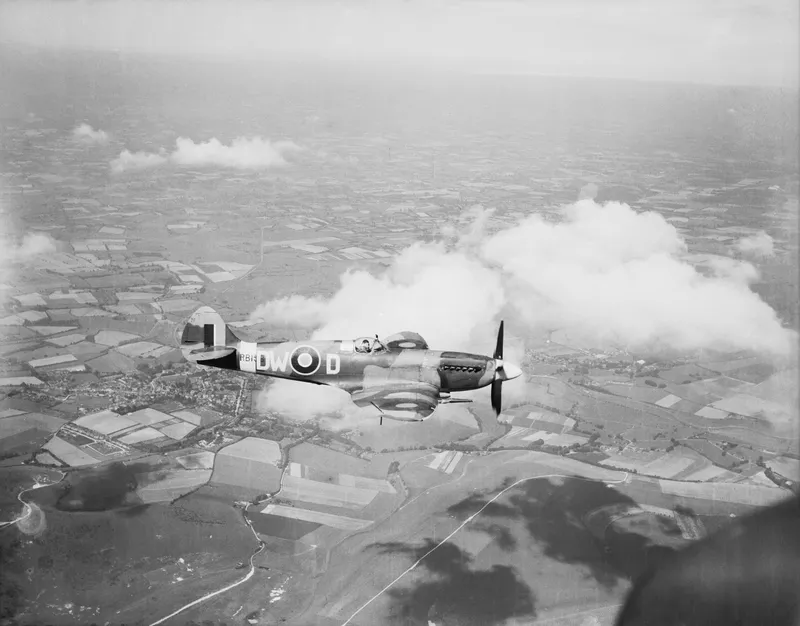
Which mark is it?
Mk XIV (No. 610 Squadron, July 1944). The Griffon marks have a five-bladed propeller.
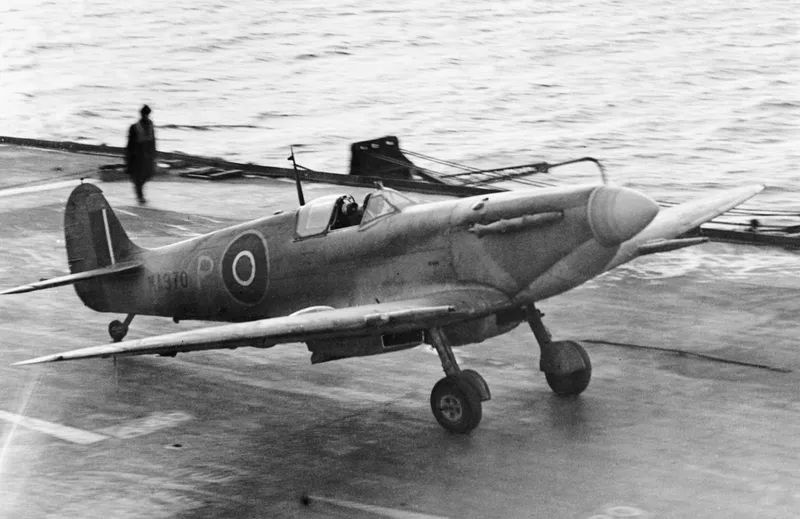
Which mark is it?
A Seafire, on HMS Illustrious in February 1943. The ship is the giveaway.
Next: specs and engines →