From the Mk I to the F.24
The Spitfire was changed all the way through the war. Here are the main marks and roles, and why the numbers jump about.
Jump to: Mk I & II | Mk V | Mk IX & XVI | Griffon marks | Photo-recce | Seafire | Production
The marks ran from 1 to 24 with many sub-marks in between, and not every number went into production. IWM: The evolution of the Supermarine Spitfire (video transcript) IWM calls it the only Allied front-line fighter in continuous development all the way through the Second World War. IWM: The evolution of the Supermarine Spitfire (video transcript)
As the war went on it got heavier armament and more powerful engines, until it was twice as heavy and twice as powerful as the original mark. Ingenium, Canada Aviation and Space Museum: Supermarine Spitfire L.F. Mk. IX Over the war, the eight .303 machine guns gave way to four 20 mm cannon. By the end there were more than 20 fighter versions alone, with Merlins of up to 1,760 hp. Britannica: Spitfire (John F. Guilmartin)
Mk I and Mk II
IWM says the Mk I’s Merlin gave about 990 hp as first designed and over 1,100 hp in fighter trim. IWM: The evolution of the Supermarine Spitfire (video transcript) Britannica gives the Merlin in the Battle of Britain version as 1,030 hp. Britannica: Spitfire (John F. Guilmartin)
Early on, a metal two-blade controllable-pitch propeller replaced the original two-blade, fixed-pitch mahogany one, and a tailwheel replaced the tail skid. Smithsonian National Air and Space Museum: Supermarine Spitfire HF. Mk. VIIc Later changes, a three-bladed metal propeller and a new cockpit hood, gave the Spitfire its familiar look. RAF Museum: The first flight of the Spitfire (Kris Hendrix)
The Mk I’s ailerons were covered in Irish linen, hand-doped to shape. IWM: The evolution of the Supermarine Spitfire (video transcript) The first cannon had to be tilted on their sides to fit the thin wing, and they could jam when a pilot pulled high-g manoeuvres. IWM: The evolution of the Supermarine Spitfire (video transcript)
Mk V
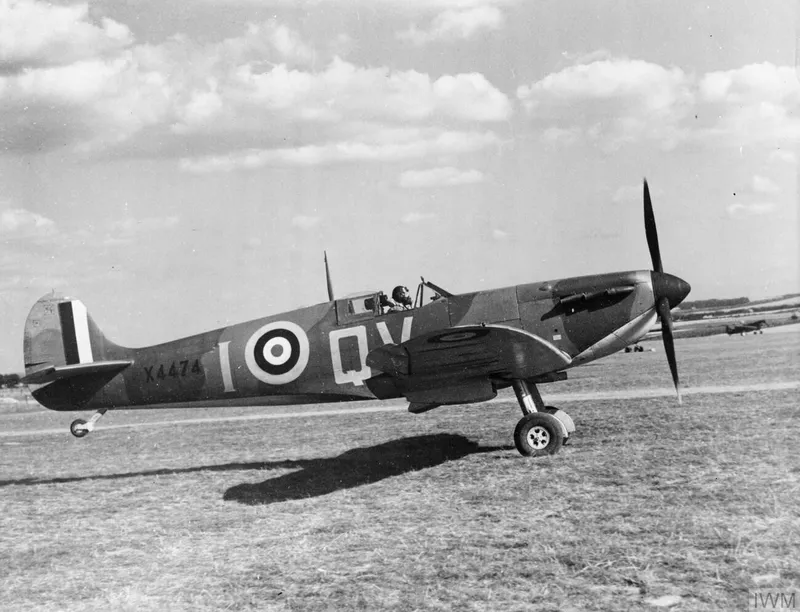
The planned Mk III, with an improved wing and a Merlin XX, had been in development for two years, but the RAF couldn’t wait for it. The Mk IV designation was already taken by another version. National Museum of the US Air Force: Supermarine Spitfire Mk. Vc IWM puts it simply: after the Battle of Britain’s Mks I and II, the next full production Spitfire was the Mk V. IWM: The evolution of the Supermarine Spitfire (video transcript)
The Mk V was a hurried interim answer to the Messerschmitt Bf 109F, which outperformed the Spitfires of the time at high altitude. National Museum of the US Air Force: Supermarine Spitfire Mk. Vc The Mk V was essentially a modified Mk II airframe with a new Rolls-Royce Merlin 45 engine. National Museum of the US Air Force: Supermarine Spitfire Mk. Vc
More than 100 Mk Is were converted into Mk Vs and began reaching squadrons in March 1941. National Museum of the US Air Force: Supermarine Spitfire Mk. Vc In total 6,464 Mk Vs were built between 1941 and 1943, equipping more than 140 RAF squadrons. National Museum of the US Air Force: Supermarine Spitfire Mk. Vc
Wing letters showed the armament: the Mk Va had eight .303 Browning machine guns, the Mk Vb two 20 mm Hispano cannon and four machine guns, and the Mk Vc a ‘universal’ wing for different combinations. National Museum of the US Air Force: Supermarine Spitfire Mk. Vc The C wing carried 120 rounds per cannon, against 60 on the B wing. National Museum of the US Air Force: Supermarine Spitfire Mk. Vc
The universal wing had strengthened landing gear moved two inches forward, to stop the Spitfire tipping onto its propeller. National Museum of the US Air Force: Supermarine Spitfire Mk. Vc
Most Mk Vs had their wingtips removed to improve low-altitude performance, and these low-altitude fighters carried the prefix L.F. National Museum of the US Air Force: Supermarine Spitfire Mk. Vc Clipping the wingtips helped the Mk V roll faster, at the cost of a less tight turn. IWM: The evolution of the Supermarine Spitfire (video transcript)
Built as a short-range home-defence fighter, the Spitfire got 30- and 90-gallon drop tanks under the fuselage once the RAF went on the offensive in 1941. National Museum of the US Air Force: Supermarine Spitfire Mk. Vc Tropicalised Mk Vs were fitted with a Vokes or a smaller Aboukir air filter to protect the engine in the desert. National Museum of the US Air Force: Supermarine Spitfire Mk. Vc
In March 1942 tropicalised Mk Vcs flew from the aircraft carrier HMS Eagle to the besieged island of Malta. Shuttleworth Collection: Supermarine Spitfire Vc In 1941 the new Focke-Wulf Fw 190 could outclass a Mk V in most respects. IWM: The evolution of the Supermarine Spitfire (video transcript)
Mk VII: high altitude
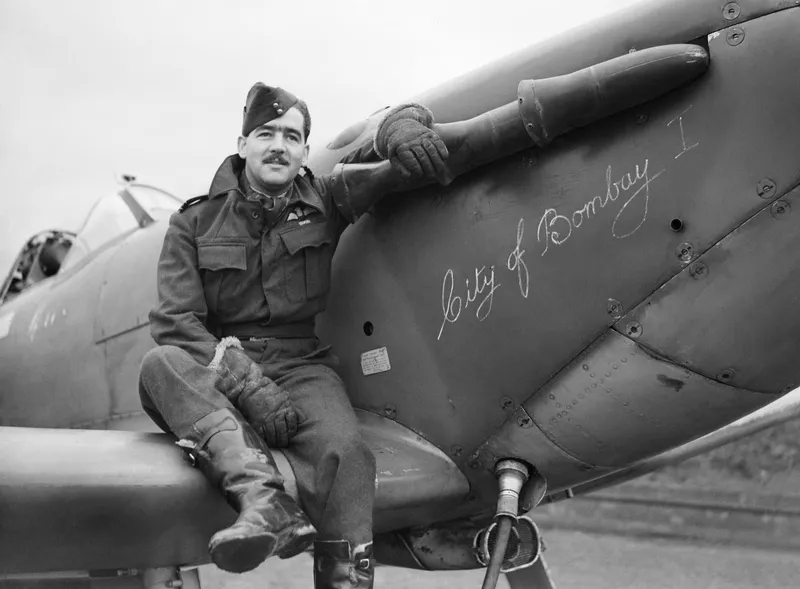
The Mk VII was the second high-altitude version, with a pressurised cockpit and extended wingtips. Only 140 were produced. Smithsonian National Air and Space Museum: Supermarine Spitfire HF. Mk. VIIc
Mk IX and Mk XVI
The Mk IX (around 1943) had a two-speed, two-stage, intercooled supercharged Merlin of 1,650–1,700 hp, a four-bladed propeller and two large radiators underneath. IWM: The evolution of the Supermarine Spitfire (video transcript) The Mk IX successfully countered the Focke-Wulf Fw 190. Ingenium, Canada Aviation and Space Museum: Supermarine Spitfire L.F. Mk. IX
Many wartime fighter pilots called the Mk IX their favourite Spitfire. IWM: The evolution of the Supermarine Spitfire (video transcript) The L.F. Mk IX had an engine tuned to give its best power lower down, and some had their wingtips removed for more speed and a faster roll. Ingenium, Canada Aviation and Space Museum: Supermarine Spitfire L.F. Mk. IX
IWM says that by the Mks VIII, IX and XVI the Merlin had been tuned about as far as it could go, at around 1,700 hp. IWM: The evolution of the Supermarine Spitfire (video transcript) The Mk XVI was the last production version with a Merlin engine. Several stayed in service until 1950. Smithsonian National Air and Space Museum: Supermarine Spitfire HF. Mk. VIIc
The Griffon marks
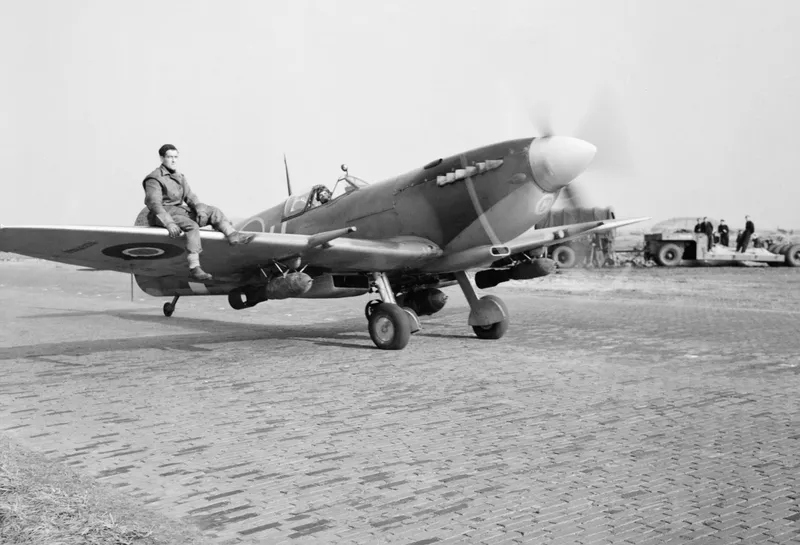
Rolls-Royce’s Griffon was a 36.9-litre V12, nearly 10 litres bigger than the Merlin and good for over 2,000 hp. IWM: The evolution of the Supermarine Spitfire (video transcript) The Griffon went first into the Mk XII and reached squadrons mainly in the Mk XIV, which had a five-bladed propeller. IWM: The evolution of the Supermarine Spitfire (video transcript)
Britannica: Griffon Spitfires of up to 2,050 hp entered service from late 1943, with top speeds of 440 mph (710 km/h) and ceilings of 40,000 ft (12,200 m), and were used to shoot down V-1 flying bombs. Britannica: Spitfire (John F. Guilmartin)
The F.24, with the 36.9-litre Griffon, was the last mark, in 1947. IWM says only 80 were made. IWM: The evolution of the Supermarine Spitfire (video transcript) The F.24’s five-bladed propeller turned the opposite way to a Merlin Spitfire’s, and it had a much bigger tail and rudder. IWM: The evolution of the Supermarine Spitfire (video transcript)
IWM Duxford’s F.24, VN485, was built in 1947, served with the Hong Kong Auxiliary Air Force and last flew in 1955. IWM: The evolution of the Supermarine Spitfire (video transcript)
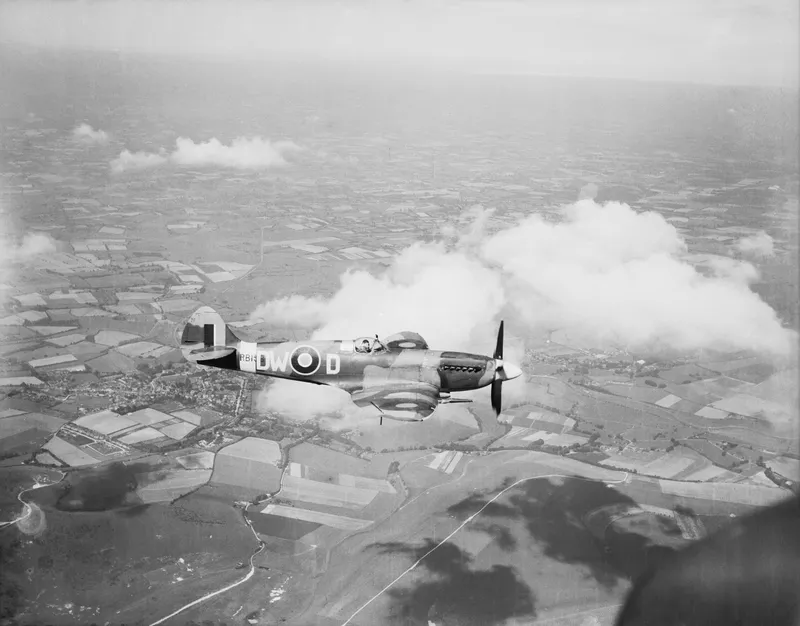
Photo-reconnaissance
Photo-reconnaissance Spitfires, from early 1941, replaced guns and ammunition bays with fuel tanks. Their high-altitude performance made them all but immune from interception. Britannica: Spitfire (John F. Guilmartin) The PR Mk XIX is a later, Griffon-powered mark. RAF BBMF: Spitfire PR Mk XIX PM631 flies again (14 Oct 2024)
The RAF’s last operational Spitfire sortie was flown by a PR Mk XIX over Malaya on 1 April 1954. RAF: Spitfire, fighter aircraft supreme Britannica: fighter Spitfires left RAF service in the early 1950s, while photo-reconnaissance Spitfires carried on until 1954. Britannica: Spitfire (John F. Guilmartin)
Other jobs
Fighter-bomber versions could carry a 250 or 500 lb bomb under the fuselage and a 250 lb bomb under each wing. Britannica: Spitfire (John F. Guilmartin) Spitfires also flew air-sea rescue, dropping a dinghy and emergency supplies to pilots down in the sea. Smithsonian National Air and Space Museum: Supermarine Spitfire HF. Mk. VIIc
Variants included photo-reconnaissance, high-altitude and low-altitude versions. Smithsonian National Air and Space Museum: Supermarine Spitfire HF. Mk. VIIc
Seafire
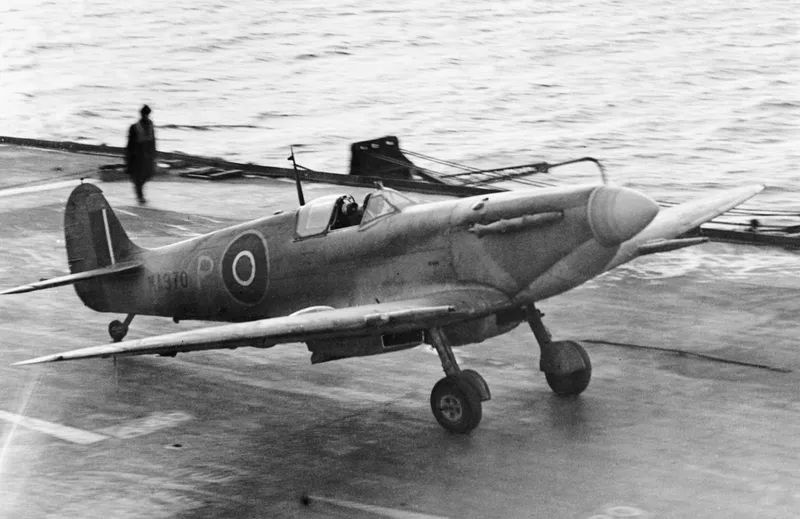
Seafires, with tail hooks and strengthened tails, flew from Royal Navy aircraft carriers from June 1942. Britannica: Spitfire (John F. Guilmartin)
Production
IWM’s Spitfire evolution video: over 20,000 built between 1937 and 1947. IWM: The evolution of the Supermarine Spitfire (video transcript) · checked 29 Oct 2026 Britannica: when production ended in 1947, 20,334 Spitfires of all versions had been built, 2,053 of them Griffon-powered. Britannica: Spitfire (John F. Guilmartin) · checked 29 Oct 2026
The Smithsonian says that when the war ended, the Spitfire was the only aeroplane that had been in continuous production all the way through it. Smithsonian National Air and Space Museum: Supermarine Spitfire HF. Mk. VIIc The L.F. Mk IX in Canada’s national collection, NH188, was built at the Castle Bromwich Aircraft Factory in 1944. Ingenium, Canada Aviation and Space Museum: Supermarine Spitfire L.F. Mk. IX
During the war small numbers were exported to Portugal, Turkey and the Soviet Union, and US Army Air Forces units flew them in Europe. Britannica: Spitfire (John F. Guilmartin) Belgian, Free French, Polish, Czech, American and British Commonwealth pilots all flew Spitfires. Smithsonian National Air and Space Museum: Supermarine Spitfire HF. Mk. VIIc
Spitfire figures depend on the mark, the engine, the load and who measured them, and the museums don’t all agree. Even the total built ranges from 20,334 to about 22,000, depending on the source and on whether Seafires are counted. Each figure on this site links to who said it. See when sources disagree for every disagreement side by side.
Next: how to identify one →