From racing seaplane to fighter, 1931–1938
How a Schneider Trophy designer, a new Rolls-Royce engine and a very thin wing became the Spitfire.
Racing seaplanes
One of Mitchell’s Schneider Trophy racing seaplanes, the S.6, set a world speed record of 357 mph (574 km/h) in 1929. Britannica: Spitfire (John F. Guilmartin) On 13 September 1931 Mitchell’s S.6B won the Schneider Trophy for Britain for the third race running, which kept the trophy in Britain for good. Smithsonian National Air and Space Museum: Supermarine Spitfire HF. Mk. VIIc
The S.6B was an all-metal, aerodynamically clean design that reached 407 mph (656 km/h). RAF Museum: The first flight of the Spitfire (Kris Hendrix)
A fighter specification
Just 18 days after that 1931 Schneider win, the Air Ministry issued Specification F7/30 for a modern all-metal, land-based fighter. RAF Museum: The first flight of the Spitfire (Kris Hendrix) Mitchell’s first answer, the Model 224, had a fixed undercarriage and a cooling system that didn’t work properly. The Air Ministry ordered the Gloster Gladiator biplane instead. RAF Museum: The first flight of the Spitfire (Kris Hendrix)
Mitchell’s team kept going, adding a Rolls-Royce Merlin engine, a retractable undercarriage, an enclosed cockpit and a new elliptical wing. RAF Museum: The first flight of the Spitfire (Kris Hendrix) The real value of the elliptical wing was that it let the wing be as thin as possible, which cut drag. RAF Museum: The first flight of the Spitfire (Kris Hendrix)
Britannica says the Spitfire was designed in response to a 1934 Air Ministry specification for a high-performance fighter with eight wing-mounted 0.303-inch (7.7 mm) machine guns. Britannica: Spitfire (John F. Guilmartin) Mitchell’s design for the eight-gun specification was the Supermarine Type 300. Smithsonian National Air and Space Museum: Supermarine Spitfire HF. Mk. VIIc
Its engine began as the Rolls-Royce PV-12, later named the Merlin. Smithsonian National Air and Space Museum: Supermarine Spitfire HF. Mk. VIIc Canadian aerodynamicist Beverley Shenstone contributed to the design. Ingenium, Canada Aviation and Space Museum: Supermarine Spitfire L.F. Mk. IX
According to IWM, the name ‘Shrew’ was considered before ‘Spitfire’ stuck. IWM: The evolution of the Supermarine Spitfire (video transcript)
R. J. Mitchell
Reginald Joseph Mitchell was born on 20 May 1895 at Talke, near Stoke-upon-Trent. Britannica: R.J. Mitchell He began as an apprentice at a locomotive works, studied at night classes, and in 1916 joined Supermarine in Southampton, where he stayed for the rest of his life. Britannica: R.J. Mitchell
Mitchell died of cancer on 11 June 1937, aged 42, before the Spitfire reached production. Smithsonian National Air and Space Museum: Supermarine Spitfire HF. Mk. VIIc IWM says the only Spitfire Mitchell ever saw fly was the prototype, K5054. IWM: The evolution of the Supermarine Spitfire (video transcript)
Joe Smith took over and oversaw the Spitfire’s development all the way from the Mk I to the F.24. IWM: The evolution of the Supermarine Spitfire (video transcript)
5 March 1936
On 5 March 1936 Captain Joseph ‘Mutt’ Summers flew the prototype, K5054, from Eastleigh Aerodrome, now Southampton Airport. RAF BBMF: Commemorating history, the 90th anniversary of the Spitfire (5 Mar 2026) Summers was chief test pilot for Vickers. RAF Museum: The first flight of the Spitfire (Kris Hendrix)
The first flight lasted around eight minutes. RAF News: Spitfire flights mark 90th anniversary of first flight (5 Mar 2026) The RAF Museum quotes Summers as saying ‘Don’t touch anything’ on landing. It explains that he wanted to report his observations before anything was changed, not that the aircraft was perfect. RAF Museum: The first flight of the Spitfire (Kris Hendrix)
The RAF’s 90th-anniversary article reports him as saying “Don’t change a thing.” RAF News: Spitfire flights mark 90th anniversary of first flight (5 Mar 2026)
After the first flights a new propeller raised the top speed to 348 mph (557 km/h), faster than the newest Hawker Hurricane. RAF Museum: The first flight of the Spitfire (Kris Hendrix) The armament was doubled from four to eight Browning machine guns. RAF Museum: The first flight of the Spitfire (Kris Hendrix)
Hard to build
On 3 June 1936 the Air Ministry ordered 310 Spitfires, a big order for the time. RAF Museum: The first flight of the Spitfire (Kris Hendrix) The Spitfire, and especially its wings, proved hard to produce, so work went to subcontractors and a new factory was built at Castle Bromwich. RAF Museum: The first flight of the Spitfire (Kris Hendrix)
Because of the delays, the Air Ministry at first planned to stop Spitfire production after the first 310. RAF Museum: The first flight of the Spitfire (Kris Hendrix) IWM says a Spitfire wing took three times as many man-hours to build as a mass-produced Messerschmitt Bf 109 wing. IWM: The evolution of the Supermarine Spitfire (video transcript)
Into service
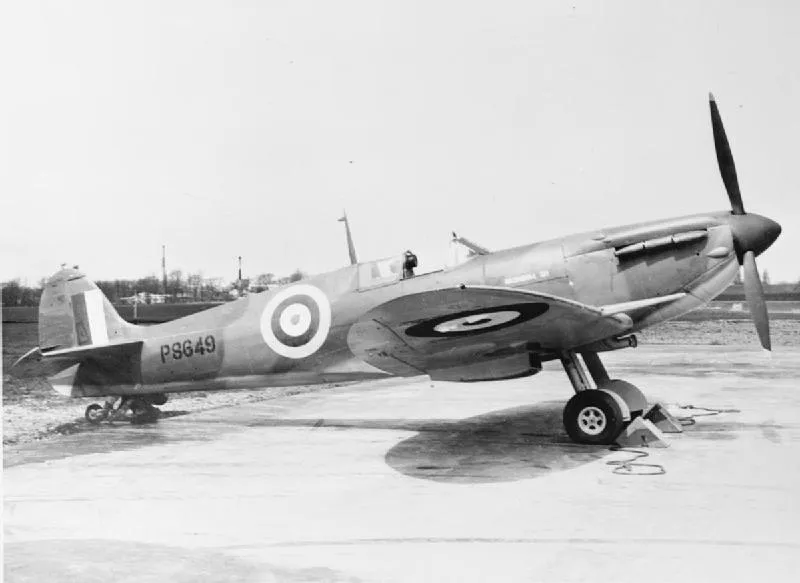
On 4 August 1938 K9789, the third Spitfire off the production line, was delivered to the RAF at Duxford. Smithsonian National Air and Space Museum: Supermarine Spitfire HF. Mk. VIIc The first Mk I went to No. 19 Squadron at RAF Duxford on 4 August 1938. RAF: Spitfire, fighter aircraft supreme
No. 66 Squadron, also at Duxford, began receiving Spitfires soon after. Smithsonian National Air and Space Museum: Supermarine Spitfire HF. Mk. VIIc At a Duxford press day in May 1939, a magazine writer called the Spitfire “a poem of speed and precision”. IWM: Duxford and the Spitfire (audio slideshow transcript)
When war broke out, the commanding officer of No. 611 Squadron drove into Cambridge to buy car mirrors for his Spitfires, because they had none. IWM: Duxford and the Spitfire (audio slideshow transcript)
September 1939
The RAF Museum says that at the outbreak of war the RAF had 306 Spitfires in service, 71 in reserve and 2,000 on order. RAF Museum: The first flight of the Spitfire (Kris Hendrix) The Smithsonian says that when war was declared, 400 Spitfires were already in service and 2,160 were on order. Smithsonian National Air and Space Museum: Supermarine Spitfire HF. Mk. VIIc
The RAF says ten Spitfire squadrons were operational by September 1939. RAF: Spitfire, fighter aircraft supreme The Smithsonian says nine fighter squadrons were fully equipped with Spitfires when war was declared, and two more were converting. Smithsonian National Air and Space Museum: Supermarine Spitfire HF. Mk. VIIc
The sources give different figures, so we show both. More on when sources disagree.
Next: marks and variants →