Spitfire specifications, by source
No single set of “Spitfire specs” exists: each mark was different, and museums quote different aircraft. So here is each source’s figure, side by side.
| Mark | Engine | Top speed | Span | Length | Weight | Ceiling | Source |
|---|---|---|---|---|---|---|---|
| Mk I (Battle of Britain) | Merlin, 1,030 hp | 360 mph | 36 ft 10 in | 29 ft 11 in | — | 34,000 ft | Britannica: Spitfire (John F. Guilmartin) |
| Mk Vc | Merlin 45, 1,470 hp | 374 mph | 36 ft 10 in (32 ft 7 in L.F.) | 29 ft 11 in | 6,785 lb | 37,000 ft | National Museum of the US Air Force: Supermarine Spitfire Mk. Vc |
| Mk Vc G-AWII | Merlin 45M, 1,440 hp | 357 mph | 32 ft 2 in | 29 ft 11 in | 5,065 lb | — | Shuttleworth Collection: Supermarine Spitfire Vc |
| HF Mk VIIc | Merlin 61, 1,565 hp | — | 36 ft 10 in | 29 ft 11 in | 2,570.5 kg | — | Smithsonian National Air and Space Museum: Supermarine Spitfire HF. Mk. VIIc |
| L.F. Mk IX NH188 | — | 404 mph | 32 ft 7 in | 31 ft 4 in | 5,816 lb empty, 7,500 lb gross | 42,500 ft | Ingenium, Canada Aviation and Space Museum: Supermarine Spitfire L.F. Mk. IX |
| Griffon marks | Griffon, up to 2,050 hp | 440 mph | — | — | — | 40,000 ft | Britannica: Spitfire (John F. Guilmartin) |
Our chart of the figures quoted by each source. Sources measured different aircraft at different heights and weights, so treat small gaps with care.
Guns
The armament was doubled from four to eight Browning machine guns. RAF Museum: The first flight of the Spitfire (Kris Hendrix) The Mk I’s eight machine guns were set to concentrate their fire on a point 300 yards ahead. Smithsonian National Air and Space Museum: Supermarine Spitfire HF. Mk. VIIc
Over the war, the eight .303 machine guns gave way to four 20 mm cannon. By the end there were more than 20 fighter versions alone, with Merlins of up to 1,760 hp. Britannica: Spitfire (John F. Guilmartin) The C wing carried 120 rounds per cannon, against 60 on the B wing. National Museum of the US Air Force: Supermarine Spitfire Mk. Vc
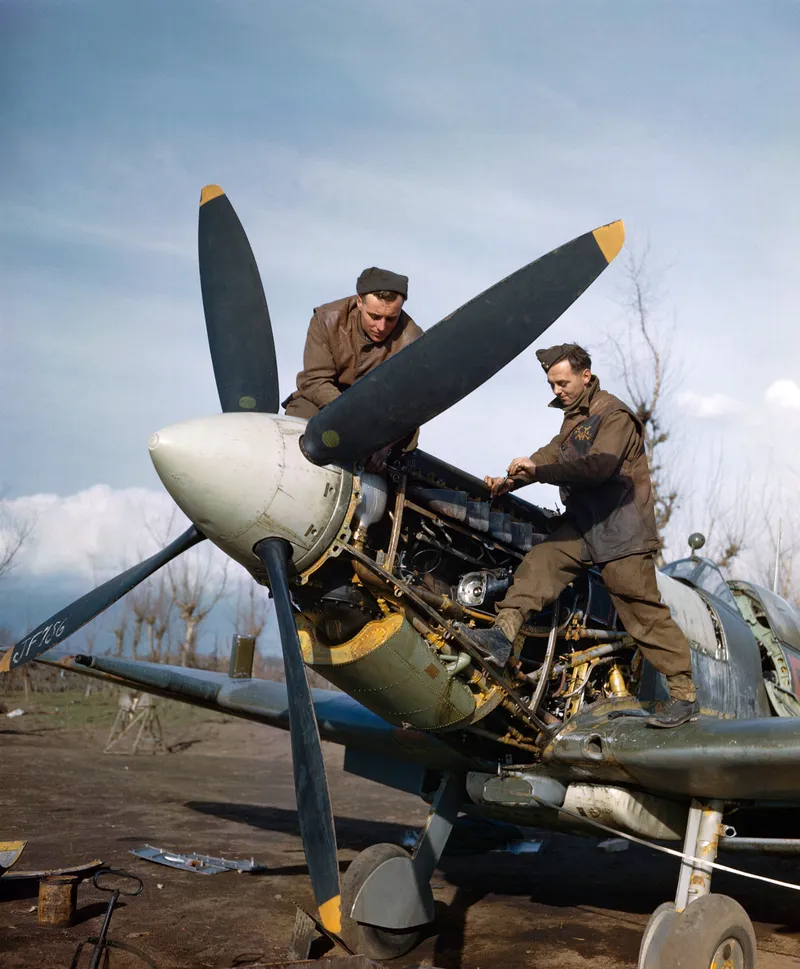
The Rolls-Royce Merlin
Rolls-Royce developed the Merlin from 1933, from an engine called the PV12, at first giving about 900–990 hp on the test bench. IWM: The Rolls-Royce Merlin engine (video transcript) Its engine began as the Rolls-Royce PV-12, later named the Merlin. Smithsonian National Air and Space Museum: Supermarine Spitfire HF. Mk. VIIc
The Merlin is a 27-litre engine, just under 1,650 cubic inches. The Daimler-Benz 601 in the Bf 109 was 39 litres, and the BMW 801 in the Fw 190 was 42. IWM: The Rolls-Royce Merlin engine (video transcript) Over 50 development types of the Merlin were built, from just over 1,000 hp to 2,050 hp. IWM: The Rolls-Royce Merlin engine (video transcript)
The Merlin also powered the Hurricane, the Mosquito, the Mustang and the Lancaster. IWM: The Rolls-Royce Merlin engine (video transcript) The carburettor-fed Merlin could flood and cough in a negative-g manoeuvre, which was bad news in a dogfight. IWM: The Rolls-Royce Merlin engine (video transcript)
The Rolls-Royce Griffon
Rolls-Royce’s Griffon was a 36.9-litre V12, nearly 10 litres bigger than the Merlin and good for over 2,000 hp. IWM: The evolution of the Supermarine Spitfire (video transcript) The Griffon went first into the Mk XII and reached squadrons mainly in the Mk XIV, which had a five-bladed propeller. IWM: The evolution of the Supermarine Spitfire (video transcript)
Britannica: Griffon Spitfires of up to 2,050 hp entered service from late 1943, with top speeds of 440 mph (710 km/h) and ceilings of 40,000 ft (12,200 m), and were used to shoot down V-1 flying bombs. Britannica: Spitfire (John F. Guilmartin)
Notes on the figures
The US Air Force museum and Shuttleworth give different figures for the same mark, the Mk Vc: different engine versions (Merlin 45 and 45M), different spans (Shuttleworth’s aircraft has the shorter, clipped span) and different weights. Neither says whether its weight is empty or loaded. Ingenium gives empty and gross weights for its L.F. Mk IX. See sources that disagree.
Next: the Battle of Britain →